Chapter 5. Concurrency And Race Conditions
5.1 Pitfalls in scull
💡Full code in https://github.com/kimgb415/modern-linux-device-driver/tree/Chapter5/Pitfalls-In-scull
kmemleak
Before we mess up the kernel memory, let’s setup kmemleak tool to detect kernel memory leaks.
- Follow descriptions in https://github.com/torvalds/linux/blob/master/Documentation/dev-tools/kmemleak.rst to enable the
kmemleaktool. - Make sure the
debugfsis mounted to use the debugging filesystem. If nothing shows up uponmount | grep debugfs, executemount -t debugfs nodev /sys/kernel/debug/.
Simulate the memory leak
We have already implemented the semaphore and properly locked our critical regions in Chapter3. To simulate the race condition upon scull_write, let us temporarily remove the locking mechanism for now.
ssize_t scull_write(struct file *filp, const char __user *buf, size_t count, loff_t *f_pos)
{
    ...
	// if (down_interruptible(&dev->sem))
	// 	return ERESTARTSYS;
    ...

done:
	// up(&dev->sem);
    ...
}
multithread_write.py is a python script that spawns threads, where each thread writes 512MB data into /dev/scull0. Let’s see if we can simulate the memory leak caused by the race condition upon memory allocation, as introduced in the book.
- Run the
multithread_write.pyfew times.⚠️ Some of the threads spawned by
multithread_write.pymight fail to complete writing due to the memory allocation error, complainingOSError: [Errno 12] Cannot allocate memory, which barely happens when locking mechanism is on. - Trigger the scan of
kmemleakthroughecho scan > /sys/kernel/debug/kmemleak.💡Switch to root before the execution. For another, scanning might take a while to complete. Kernel will log the message regarding the detection of new memory leak, which can be seen in
dmesgor/var/log/kern.log.
- Monitor the report of
kmemleakthroughcat /sys/kernel/debug/kmemleak.
Boom! Memory leaks indeed occurred, originating from the program whose name is python3. It’s clear which script is responsible for the whole mess😉
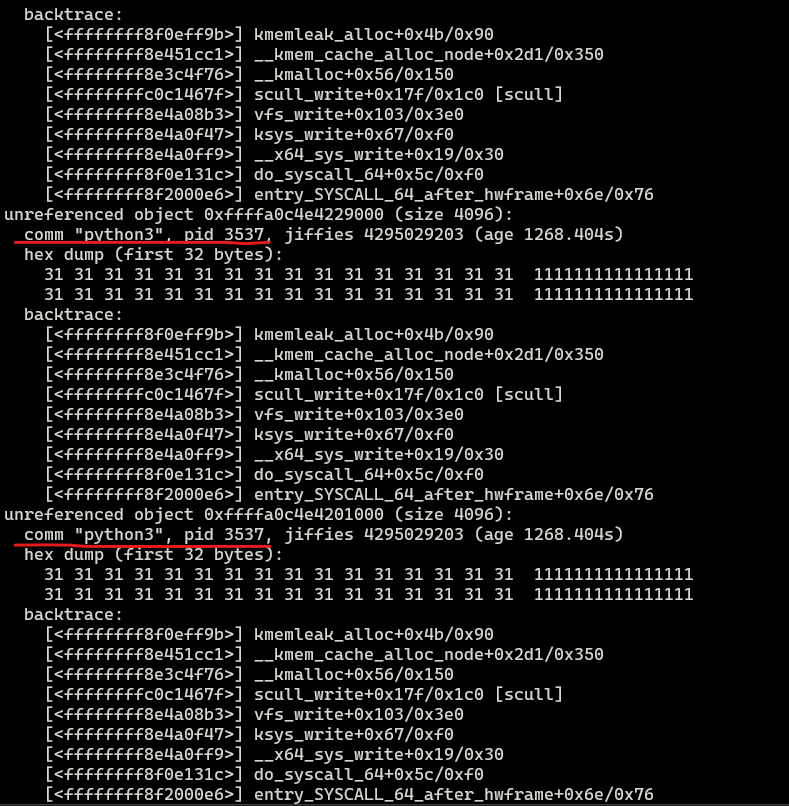
If we turn the locking back on and run it again, we won’t see any report of memory leak no matter how many time we run the script.
💡With locking mechanism back on, it takes much more time to complete the execution of the script.
5.4 Completions
💡Full code in https://github.com/kimgb415/modern-linux-device-driver/tree/Chapter5/Completions
misc_load and misc_unload for miscellaneous modules
These shell scripts are quite similar with the ones for scull device with two tiny differences.
- One and only argument is required to specify the module to load or unload.
- Only one corresponding device node will be created or removed.
misc_load
#!/bin/sh
module="$1"
device="$1"
mode="664"

# invoke insmod
# if insmod fails, the script will exit with error code of 1
/sbin/insmod ./$module.ko || exit 1

rm -rf /dev/${device}

# use awk to retrive the major number
# from the line where the second field equals to out module name
major=$(awk "\$2==\"$module\" {print \$1}" /proc/devices)

# create only one device node
mknod /dev/${device} c $major 0

group="staff"
grep -q "^staff:" /etc/group || group="wheel"

# since this script must be run by root
chgrp $group /dev/${device}
chmod $mode /dev/${device}
misc_unload
#!/bin/sh
module="$1"
device="$1"

# invoke rmmod
/sbin/rmmod $module || exit 1

# Remove stale nodes
rm -f /dev/${device} /dev/${device}
complete module
Module to test the completion is quite simple and almost the same with the one in the book.
complete_read
- When a user process attempts to read the complete char device, the driver simply puts it into sleep.
- If awaken, the driver will notify the user process with a simple message.
- Following read system calls from the same user process will receive EOF.
ssize_t complete_read(struct file *filp, char __user *buf, size_t count, loff_t* offset)
{
    // Alawys signal EOF after the first read
    if (*offset)
        return 0;

    MDEBUG("Process %i (%s) going to sleep\n", current->pid, current->comm);
    if (wait_for_completion_interruptible(&comp))
        return -ERESTARTSYS;

    MDEBUG("Awoken process %is (%s)\n", current->pid, current->comm);

    char temp[50] = "Writer finally worte something\n";
    if (copy_to_user(buf, temp, sizeof(temp)))
        return -EFAULT;

    *offset += sizeof(temp);

    return sizeof(temp);
}
complete_write
Whenever a user process finally writes to the device, those sleeping reader processes will be awakened.
ssize_t complete_write(struct file *filp, char __user *buf, size_t count, loff_t* offset)
{
    MDEBUG("Process %i %s awakening the readers...\n", current->pid, current->comm);
    complete(&comp);

    return count;
}
Test complete.ko
cat /dev/completewill hang once executed.
- Execute
echo hello | sudo dd of=/dev/completeto write to the device. - The reader process is awaken with the log message

5.6 Locking Traps
Quick note of this section is that our implementation till now adheres to the locking rule, where internal static functions always assume functions called from outside have already taken care of the proper locking. So far, we have two internal functions follow this rule.
scull_read_utilscull_follow