Chapter 3. Char Drivers
| Syntax | Description | |
|---|---|---|
| Definition | kernel macro for kernel modules | command line utility in Unix and Linux systems |
| Functionality | to create a device number, which will be used by kernel to reference the device | to create devices files in the file system |
With the above knowledge in mind, I considered the reordering of the implementation as below more appropriate in the developer’s pointer of view.
3.4 Char Device Registration
💡Full code in Char Device Registration
scull.h
Header file defines the minimum information for char device registration
#ifndef SCULL_MAJOR
#define SCULL_MAJOR 0   /* dynamic major by default */
#endif

#ifndef SCULL_NR_DEVS
#define SCULL_NR_DEVS 4    /* scull0 through scull3 */
#endif

#include <linux/cdev.h>

extern int scull_major;
extern int scull_nr_devs;

struct scull_dev {
	struct cdev cdev;
};
main.c
Modules parameters are initialized and defined
#include <linux/moduleparam.h>
#include "scull.h"


int scull_major =   SCULL_MAJOR;
int scull_minor =   0;
int scull_nr_devs = SCULL_NR_DEVS;	/* number of bare scull devices */

// S_IRUGO: parameter that is read only by the world
// S_IRUGO | S_IWUSR: parameter can only be modified by the root user
module_param(scull_major, int, S_IRUGO);
module_param(scull_minor, int, S_IRUGO);
module_param(scull_nr_devs, int, S_IRUGO);
Then we define array of scull devices and functions to register char device.
struct scull_dev *scull_devices;	/* allocated in scull_init_module */

struct file_operations scull_fops = {
	.owner =    THIS_MODULE,
	};

/*
 * The cleanup function is used to handle initialization failures as well.
 * Thefore, it must be careful to work correctly even if some of the items
 * have not been initialized
 */
void scull_cleanup_module(void)
{
	dev_t devno = MKDEV(scull_major, scull_minor);

	/* Get rid of our char dev entries */
	if (scull_devices) {
		for (int i = 0; i < scull_nr_devs; i++) {
			cdev_del(&scull_devices[i].cdev);
		}
		kfree(scull_devices);
	}

	/* cleanup_module is never called if registering failed */
	unregister_chrdev_region(devno, scull_nr_devs);
}

static void scull_setup_cdev(struct scull_dev *dev, int index)
{
	int devno = MKDEV(scull_major, scull_minor + index);
	cdev_init(&dev->cdev, &scull_fops);
	dev->cdev.owner = THIS_MODULE;
	dev->cdev.ops = &scull_fops;
	int err = cdev_add(&dev->cdev, devno, 1);
	/* Fail gracefully if need be */
	if (err)
		pr_warning("Error %d addding scull%d\n", err, index);
}

static int __init scull_init_module(void)
{
	int result;
	dev_t dev = 0;

	/*
	* Get a range of minor numbers to work with, asking for a dynamic
	* major unless directed otherwise at load time.
	*/
	if (scull_major) {
		dev = MKDEV(scull_major, scull_minor);
		result = register_chrdev_region(dev, scull_nr_devs, "scull");
	} else {
		result = alloc_chrdev_region(&dev, scull_minor, scull_nr_devs,
				"scull");
		scull_major = MAJOR(dev);
	}
	if (result < 0) {
		pr_warning("scull: can't get major %d\n", scull_major);
		return result;
	}

	/*
	 * allocate the devices -- we can't have them static, as the number
	 * can be specified at load time
	 */
	scull_devices = kmalloc(scull_nr_devs * sizeof(struct scull_dev), GFP_KERNEL);
	if (!scull_devices) {
		result = -ENOMEM;
		goto fail;  /* Make this more graceful */
	}
	memset(scull_devices, 0, scull_nr_devs * sizeof(struct scull_dev));

	for (int i = 0; i < scull_nr_devs; ++i)
		scull_setup_cdev(&scull_devices[i], i);

	return 0;

fail:
	scull_cleanup_module();
	return result;
}
Note that scull_cleanup_module function is not marked as __exit anymore, since it is not only used upon module_exit
3.2 Major and Minor Numbers
💡Full code in Major and Minor Numbers
Scripts for module loading and unloading are almost the same with those shown in the book
scull_load
#!/bin/sh
module="scull"
device="scull"
mode="664"

# invoke insmod with all arguments we got
# if insmod fails, the script will exit with error code of 1
/sbin/insmod ./$module.ko $* || exit 1

rm -rf /dev/${device}[0-3]

# use awk to retrive the major number
# from the line where the second field equals to out module name
major=$(awk "\$2==\"$module\" {print \$1}" /proc/devices)

for i in 0 1 2 3; do
	mknod /dev/${device}$i c $major $i
done

group="staff"
grep -q "^staff:" /etc/group || group="wheel"

# since this script must be run by root
chgrp $group /dev/${device}[0-3]
chmod $mode /dev/${device}[0-3]
scull_unload
#!/bin/sh
module="scull"
device="scull"

# invoke rmmod with all arguments we got
/sbin/rmmod $module $* || exit 1

# Remove stale nodes
rm -f /dev/${device} /dev/${device}[0-3]
When we run make && sudo ./scull_load , we will see the driver modules has been inserted and the devices are created.

Then we run sudo ./scull_unload , all stuffs are gone now

3.5 open and release
💡Full code in open and release
main.c
Here we implement the simplest open and release methods.
/*
 * Open and close
 */
int scull_open(struct inode *inode, struct file *filp)
{
	struct scull_dev *dev;

	dev = container_of(inode->i_cdev, struct scull_dev, cdev);
	filp->private_data = dev;

	pr_debug("scull device is opened\n");

	return 0;
}

int scull_release(struct inode *inode, struct file *filp)
{
	pr_debug("scull device is released\n");
	return 0;
}

struct file_operations scull_fops = {
	.owner =    	THIS_MODULE,
	.open = 		scull_open,
	.release = 		scull_release,
};
With above methods ready, we can see the debug messages in scull_open and scull_release when we execute cat /dev/scull0.
3.6 scull’s Memory Usage
💡Full code in scull’s Memory Usage
It’s time to implement the core memory layout of scull device driver.
scull.h
scull_dev->data field is the head of the list, where each list node contains a 2d pointer array of void **, resulting in the 3d memory layout for the entire scull device.
/*
 * The bare device is a variable-length region of memory.
 * Use a linked list of indirect blocks.
 *
 * "scull_dev->data" points to an array of pointers, each
 * pointer refers to a memory area of SCULL_QUANTUM bytes.
 *
 * The array (quantum-set) is SCULL_QSET long.
 */
#ifndef SCULL_QUANTUM
#define SCULL_QUANTUM 4000
#endif

#ifndef SCULL_QSET
#define SCULL_QSET    1000
#endif

// ...
/*
 * Representation of scull quantum sets.
 */
struct scull_qset {
	void **data;
	struct scull_qset *next;
};

struct scull_dev {
	struct scull_qset *data;  /* Pointer to first quantum set */
	int quantum;              /* the current quantum size */
	int qset;                 /* the current array size */
	unsigned long size;       /* amount of data stored here */
	struct semaphore sem;     /* mutual exclusion semaphore     */
	struct cdev cdev;	  /* Char device structure		*/
};
main.c
Code additions here are mainly about cleaning the memory area of scull device and other necessary initialization steps. The biggest change is the addition of scull_trim function
/*
 * Empty out the scull device; must be called with the device
 * semaphore held.
 */
int scull_trim(struct scull_dev *dev)
{
	struct scull_qset *curr, *next;
	int qset = dev->qset;

	// every kmalloced pointer should be kfreed from inside out
	for (curr = dev->data; curr; curr = next) {
		if (curr->data) {
			for (int i = 0; i < qset; ++i)
				kfree(curr->data[i]);
			kfree(curr->data);
			curr->data = NULL;
		}
		next = curr->next;
		kfree(curr);
	}

	// reset all the information of scull_dev
	dev->size = 0;
	dev->quantum = scull_quantum;
	dev->qset = scull_qset;
	dev->data = NULL;

	return 0;
}
For another, init_MUTEX is deprecated now. Hence, sema_init should be used in scull_init() to initialize semaphore
static int __init scull_init_module(void)
{
	// ...
	for (int i = 0; i < scull_nr_devs; ++i) {
		scull_devices[i].quantum = scull_quantum;
		scull_devices[i].qset = scull_qset;
		sema_init(&scull_devices[i].sem, 1);
		scull_setup_cdev(&scull_devices[i], i);
	}
	// ...
}
If we add debug message in scull_open as below, we can see the device is opened with O_WRONLY when executing echo hello | sudo dd of=/dev/scull0.
int scull_open(struct inode *inode, struct file *filp)
{
	struct scull_dev *dev;

	dev = container_of(inode->i_cdev, struct scull_dev, cdev);
	filp->private_data = dev;

	if ((filp->f_flags & O_ACCMODE) == O_WRONLY) {
		if (down_interruptible(&dev->sem))
			return -ERESTARTSYS;
		printk(KERN_DEBUG "scull device is opened with O_WRONLY flag\n");
		scull_trim(dev);
		up(&dev->sem);
	}
	printk(KERN_DEBUG "scull device is opened\n");

	return 0;
}
3.7 read and write
💡Full code in read and write
scull_read
It was quite hard for me to understand the scull_read in the example code at first glance. It turns out scull_read should take care of 3 cases of read request from user space in total.
- The required offset is already beyond the EOF of device file
- Though the offset is within the file, required count of bytes to read will go over EOF.
- Both offset and count are small enough
Case 2 and 3 are the ones user can actually read something from our scull device, however,
scull_readis implemented to return no more than a single quantum of data
Another thing I struggled is to how to reach the target quantum from loff_t *f_pos. Here is the visualization example of retrieving the target quantum
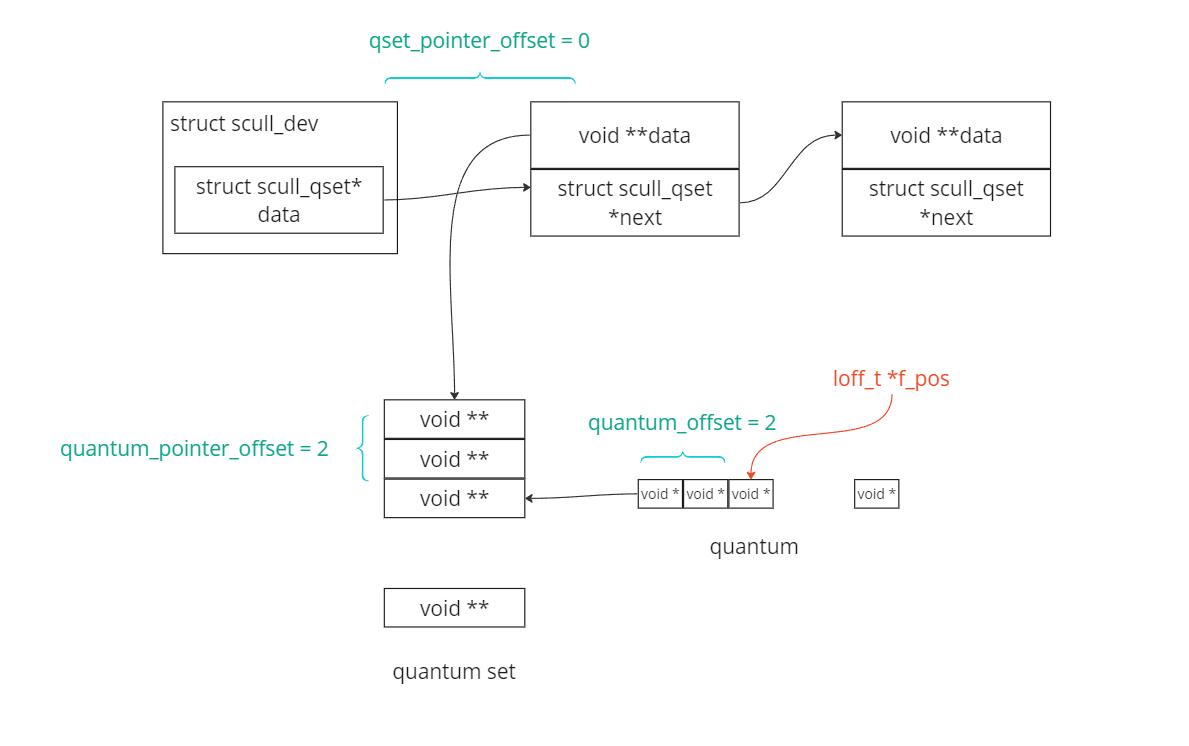
With all the details above, hope it is better to understand the following scull_read.
ssize_t scull_read(struct file *filp, char __user *buf, size_t count, loff_t *f_pos)
{
	ssize_t retval = 0;
	struct scull_dev *dev = filp->private_data;

	if (down_interruptible(&dev->sem)) {
		retval = -ERESTARTSYS;
		return retval;
	}

	// case 1. offset is alreay beyond EOF
	if (*f_pos >= dev->size)
		goto done;

	// case 2. offset is within EOF, while offset + count is beyond EOF
	if (*f_pos + count > dev->size)
		count = dev->size - *f_pos;

	// case 3. offset + count is within EOF, look for the target quantum to copy to user space
	int list_node_size = dev->qset * dev->quantum;
	// locate the q_set list node
	int qset_pointer_offset = *f_pos / list_node_size;
	struct scull_qset *target = scull_follow(dev, qset_pointer_offset);

	// then the quantum pointer, finally pinpoint the f_pos within the quantum
	int quantum_pointer_offset = (*f_pos % list_node_size) / dev->quantum;
	int quantum_offset = (*f_pos % list_node_size) % dev->quantum;

	if (!target || !target->data || !target->data[quantum_pointer_offset])
		goto done;

	// read only up to the end of this quantum
	count = min(count, (size_t)dev->quantum - quantum_offset);
	if (copy_to_user(buf, target->data[quantum_pointer_offset] + quantum_offset, count)) {
		retval = -EFAULT;
		goto done;
	}
	*f_pos += count;
	retval = count;

done:
	up(&dev->sem);
	printk(KERN_INFO "read %ld bytes from scull device", retval);

	return retval;
}
scull_write
scull_write is almost the same as scull_read, however, we have to allocate the memory by ourselves throughout the way to reach target quantum.
Don’t forget to update the dev->size, since new data is written to our device.
ssize_t scull_write(struct file *filp, const char __user *buf, size_t count, loff_t *f_pos)
{
	ssize_t retval = -ENOMEM;
	struct scull_dev *dev = filp->private_data;

	if (down_interruptible(&dev->sem))
		return ERESTARTSYS;


	int list_node_size = dev->qset * dev->quantum;
	// locate the q_set list node
	int qset_pointer_offset = *f_pos / list_node_size;
	struct scull_qset *target = scull_follow(dev, qset_pointer_offset);
	if (!target)
		goto done;

	// then the quantum pointer, finally pinpoint the f_pos within the quantum
	int quantum_pointer_offset = (*f_pos % list_node_size) / dev->quantum;
	int quantum_offset = (*f_pos % list_node_size) % dev->quantum;

	// allocate quantum set if needed
	if (!target->data) {
		target->data = kzalloc(dev->qset * sizeof(void *), GFP_KERNEL);
		if (!target->data)
			goto done;
	}

	// allocate quantum if needed
	if (!target->data[quantum_pointer_offset]) {
		target->data[quantum_pointer_offset] = kzalloc(dev->quantum, GFP_KERNEL);
		if (!target->data[quantum_pointer_offset])
			goto done;
	}

	// write only up to this quantum
	count = min(count, (size_t)dev->quantum - quantum_offset);
	if (copy_from_user(target->data[quantum_pointer_offset] + quantum_offset, buf, count)) {
		retval = -EFAULT;
		goto done;
	}

	*f_pos += count;
	retval = count;

	// update size of the device
	dev->size = max((unsigned long)*f_pos, dev->size);

done:
	up(&dev->sem);
	printk(KERN_INFO "write %ld bytes to scull device", retval);

	return retval;
}
scull_follow
scull_follow is a utility function used in both scull_read and scull_write to reach the struct scull_qset * list node with given offset from the list head. It simply traverse through the list nodes and allocate memory for the list nodes if needed
// scull device lazily initialize
struct scull_qset* scull_follow(struct scull_dev *dev, int n)
{
	// initialize the list head if needed
	if (!dev->data) {
		dev->data = kzalloc(sizeof(struct scull_qset), GFP_KERNEL);
		if (!dev->data)
			return NULL;
	}

	struct scull_qset *target = dev->data;
	while (n--) {
		if (!target->next) {
			target->next = kzalloc(sizeof(struct scull_qset), GFP_KERNEL);
			if (!target->next)
				return NULL;
		}
		target = target->next;
	}
	return target;
}
Test read and write
test_read_and_write.py is a simple python script to write data to and read data from /dev/scull0. We can verify the successful read and write with sudo -E python3 test_read_and_write.py both.

Notes
Patterns of memset following kmalloc are replaced by one line of kzalloc.